Showing posts with label American West. Show all posts

Monday, January 25, 2016

Rock Creek Station XP: Where "Bill" Hickok Became "Wild"


McCanles fight according to legend
James Butler "Wild Bill" Hickok is another of the Western men whose legend eclipsed the man.  Dime novel hero, crack pistol shot, cold eyed killer, a fine specimen of rugged Western manhood, protector of feminine virtue, gambler, lawman.  Finding the event that gave birth to the legend is not difficult, but wrestling away fiction from fact is another story, altogether.  The birthplace of the "Wild Bill" legend is Rock Creek Station, near Fairbury, Nebraska and his fight with the "notorious McCanles Gang".

Much of Wild Bill's legend stemmed from his physical presence.  A large muscular man with steel gray eyes, flowing auburn locks and mustache, he was attractive to the ladies and intimidating to other men.  From a young age, he trained himself to be a crack shot, and loved to have an audience at target practice.  The more people that knew he could shoot well, the fewer he would likely have to fight.  By all accounts, he was calm under fire, and once he decided to shoot, he would shoot to kill.

One of the players in the Rock Creek incident, Sarah Shull remembered Hickok:  "Hickok has steel-blue eyes that were beautiful and gentle but could change in a second and look dangerous.  You had better watch his eyes; he wasn't one to run from a fight."

Wild Bill and the McCanles Gang - According to Hickok (Abridged)
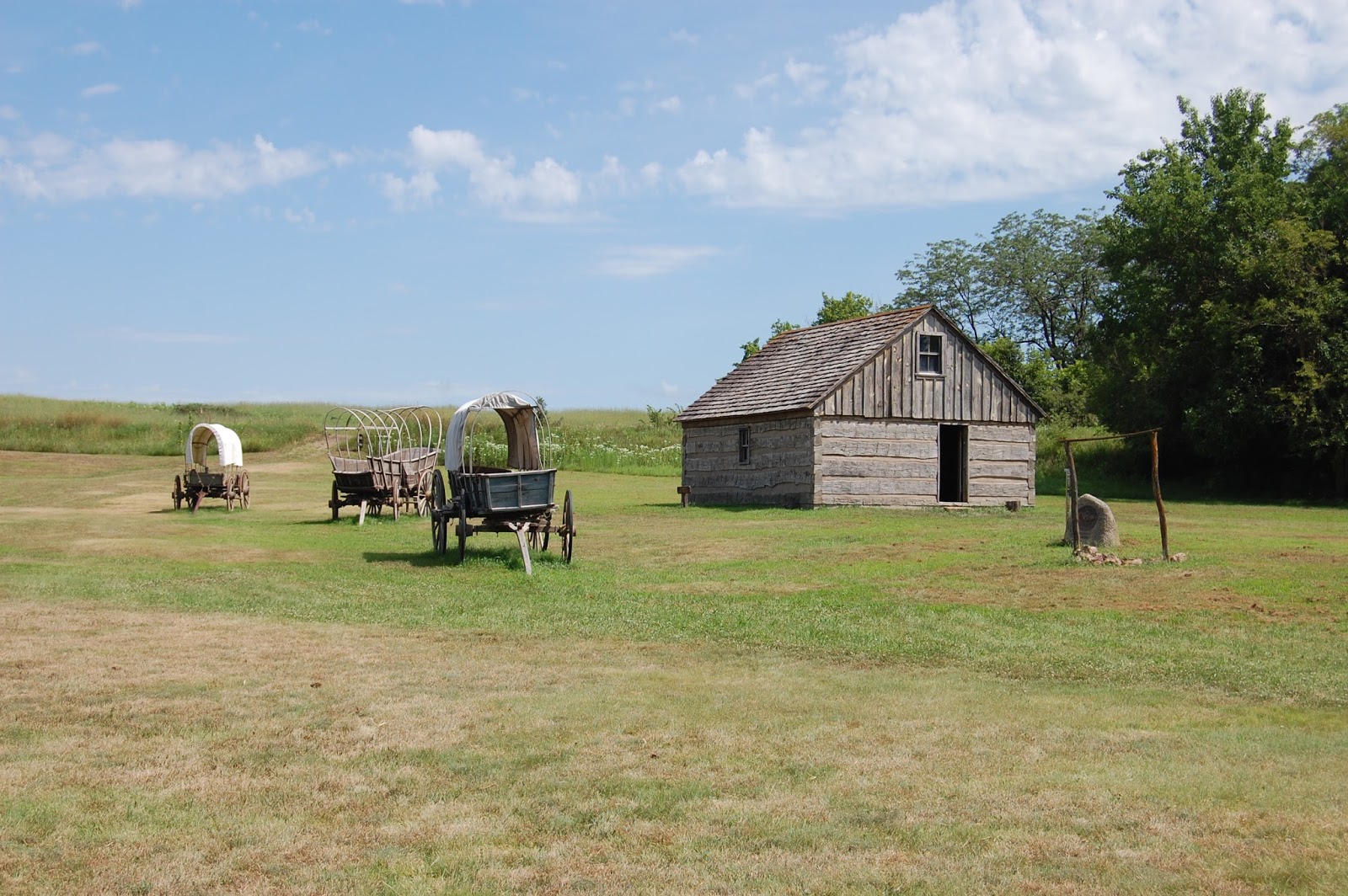

Reconstructed Rock Creek Station Cabin
When recounting the story of shooting at Rock Creek Station, Bill paints Dave McCanles as the bully leader of a gang of murdering desparadoes, horse-thieving cutthroats who terrorized settlers on the Nebraska-Kansas border.  Hickok states that he was a scout for the US cavalry bringing through soldiers from Camp Floyd when he rode up to the station on 12 July 1861.  He says he found the station superintendent's wife in hysterics, her husband shot dead.  Hickok was in the house when the Gang rode up dragging a minister to the station by the neck with a rope.

Dave McCanles c. 1859
Recognizing Hickok's horse, McCanles comes into the front door of the station cabin with a gun drawn.  Hickock shoots Dave McCanles through the heart, which only enrages the nine men with him.  As the men poured into the cabin, Hickok opens up with his pistol, killing four more men.  The fight becomes a desperate hand to hand struggle during which Hickok shoots one man, knocks another one out before he is shot with shotgun pellets and struck with a rifle butt.  In the confused fight he gains a knife and starts slashing at the rest of the men, eventually subduing them all before walking a way, falling into a faint.  He claims to be shot with 11 buck shot and cut in 13 places, all of the knife wounds being life-threatening.

It is a great story and really entertained Colonel George Ward Nichols, who wrote it up for Harper's Weekly in 1867.  Problem is, it is a story and a greatly inflated one at that.  When Hickok was put on trial for McCanles' murder, there was not a scratch on him.  Furthermore, the dead superintendent, felled by a shot in the head, was present at the trial as a co-defendant.  There were not 11 dead men at the station, rather there were only three; McCanles; his cousin and a hired-hand of McCanles'.  There is also no pay record that would substantiate Hickok's claim that he was serving as a scout for the cavalry.


Getting to Rock Creek - Wild Bill


James Butler "Wild Bill" Hickok
Like many other colorful figures of the American West, James Butler Hickok was born in what seems to be a much tamer environment, Homer (now Troy Grove) Illinois on 27 May 1837.  Raised by devout Baptist parents, William and Polly (Butler) Hickok, young James yearned for fame and honed his shooting skills as soon as he could.  His parents became caught up in the abolitionist movement, and the family home reportedly served as a station on the "Underground Railroad".  Once his father died, James provided game for the family to eat, relying on those sharpshooting skills.

In June 1856, James headed out west for the newly opened Kansas Territory.  At this time, settlers were strongly polarized into pro-slavery (Missourians/Border Ruffians) and anti-slavery (Free State/Free Soil/Jayhawkers) factions.  James Butler Hickok joined with James Lane's Free State "army" and became Lane's personal bodyguard.  Hickok was also looking for land to farm and staked a 160 acre claim in modern-day Lenexa, Kansas.  He was elected a constable in Monticello Township, Johnson County, Kansas in 1858.

Setup of the inside of the cabin
It was during this time that James Hickok started using the aliases William Hickok and William Haycock.  He would also be nicknamed Shanghai Bill and Dutch Bill, although it is difficult to see the reasons.  Finding out that his claim had been preempted, Bill struck out to see more of the West.  He was employed first as a teamster for the freighting company of Jones and Cartwright from 1858 - April 1861.  He arrived at Rock Creek Station shortly after Horace Wellman took over as station superintendent for Russell, Majors and Waddell's Pony Express.  Exactly what Bill's role was at the station is unknown, since there is no evidence that he was actually an employee of Russell, Majors and Waddell.  It is possible that Wellman personally hired him as a stockhandler or even as an enforcer.

Getting to Rock Creek - Dave McCanles


Reconstruction of West Ranch building
Not nearly as much is known about the other man that figures in this fight, David Colbert McCanles.  We know he was born in Iredell County, North Carolina on 20 November 1828 and moved with his family to Watauga County, NC.  Records show that he served as deputy sheriff of Watauga County from 1852-1856 and sheriff from 1856-1859.  Descriptions picture him as a large, powerful man.  He married young, listed as a farmer in Watauga County in 1850 with wife Mary (18 years) and son William M. (Monroe), age 1.

Reconstructed toll bridge between West and East Ranches
David later took a mistress, Sarah Shull, abandoning his family by 1859 and heading west with Sarah.  Originally headed to the Colorado gold fields, he was dissuaded from traveling all of the way by returning and disappointed gold-seekers.  He bought the Rock Creek Station property from Newton and S.C. Glenn.  The property was crossed by the Oregon-California Trail and did a business in supplying emigrants and serving as a campground.  He soon built a toll bridge over the creek there, charging 10-50 cents per wagon to cross.  The original ranch was on the west side of the creek, but he was soon able to set up a ranch on the east side, as well.  Apparently having a change of heart about his family, he sent east for his wife and children, but Sarah remained as a "domestic".  What Mary thought of this arrangement I do not know, but it was likely not comfortable.

Census entry for McCanles family in Jones County, Nebraska Territory, 1860

Reconstructed bunkhouse of East Ranch
It is agreed that Dave McCanles was a man who liked to have his way, and he would push other people around to further his desires.  It is thought that the appearance of Hickok in the community upset the balance of power in the neighborhood,  Many historians suggest that Sarah Shull was taken with Hickock and welcomed his advances, inciting McCanles' jealousy, although Sarah later stated that this was not so.  Even if this is true, it was only a contributing factor to the fight.  The most immediate cause was McCanles' impatience with collecting a debt from Russell, Majors and Waddell, whose company was bankrupt following the loss of mail contracts.

Stable and corral


Russell, Majors and Waddell's Central Overland California and Pike's Peak Express Company had leased the east ranch from McCanles in 1861, then arranged to buy it in April 1861 for 1/3 down, with the rest of the payment due in three monthly installments.  At that time the company was not making payroll on time and was behind on the payments.  Having been left holding the bag by a freight company one other time, McCanles was determined to either get his money or get his property back.  He just wasn't entirely sure whether the company was not going to pay up, or if Wellman had already received the money, but was keeping it for himself.

Rock Creek Station Accomodations - Sir Richard Burton


Sir Richard Burton c. 1875 painting by Frederic Leighton
Noted explorer Sir Richard Burton (not the actor, rather the translator of The Arabian Nights), stayed here on 08 August 1860 and wrote in his book City of the Saints, and Across the Rocky Mountains to California:

"A weary drive over a rough and dusty road, through chill night air and clouds of musquetoes, which we were warned would accompany us to the Pacific slope of the Rocky Mountains, placed us about 10 P.M. at Rock, also called Turkey Creek surely a misnomer ; no turkey ever haunted so villainous a spot! Several passengers began to suffer from fever and nausea ; in such travel the second night is usually the crisis, after which a man can endure for an indefinite time. The 'ranch' was a nice place for invalids, especially for those of the softer sex. Upon the bedded floor of the foul "doggery" lay, in a seemingly promiscuous heap, men, women, children, lambs, and puppies, all fast in the arms of Morpheus, and many under the influence of a much jollier god. The employes, when aroused pretty roughly, blinked their eyes in the atmosphere of smoke and musquetoes, and declared that it had been 'merry in hall' that night the effects of which merriment had not passed off. After half an hour's dispute about who should do the work, they produced cold scraps of mutton and a kind of bread which deserves a totally distinct generic name. The strongest stomachs of ,the party made tea, and found some milk which was not more than' one quarter flies. This succulent meal was followed by the usual douceur. On this road, however mean or wretched the fare, the station- keeper, who is established by the proprietor of the line, never derogates by lowering his price." Burton would declare Rock Creek Station "the ne plus ultra of Western discomfort".

The McCanles Murder According to Monroe McCanles (Abridged)


Front door of cabin, Oregon Trail coming from left
Monroe would say that Dave McCanles, James Woods, James Gordon and himself arrived unarmed at the East Ranch.  His father directed him to stay outside and entered the cabin.  A shot rang out and Dave stumbled out, collapsed and died trying to say something to his son, but was unable.  Woods and Gordon had been looking for McCanles stock and harness, but hearing the shot, ran up to the house.  Woods approached from the rear and Gordon approached from the front.  Both were apparently shot by Hickok.  Grabbing a hoe, Mrs. Wellman chased off Monroe, started yelling "Kill them all" and hacked Woods to death with the hoe.  Gordon made a break for the timber, but was followed by his dog, which gave his whereabouts away.  It was unclear who fired the shot that killed Gordon, and he was buried on the spot.  Monroe was able to follow a dry creek bed to safety, and alert his mother to what had happened.  The mother then sent for Dave McCanles' brother James, who alerted authorities in Beatrice, Nebraska.

Rock Creek property after the McCanles affair

What really happened?


Hickok at about the time of the Rock Creek Station incident
Nobody can really know for sure, but by cutting the stories from the two camps down the middle, we can probably come pretty close.  This is likely a fight that is more about McCanles and Wellman than Hickok.  David McCanles had accused Jane Wellman's father of stealing, and had allegedly beaten the older man earlier.  Earlier in the month, McCanles had sent his son Monroe with Wellman to try to collect payment from the section head of the Central Overland Company in Brownville, Nebraska.  While they were away, McCanles tried to push Mrs. Wellman into turning over the ranch property to him.  She had no use for McCanles and let him have an earful.

David McCanles usually carried a shotgun on his saddle and two pistols on his person, which was not unusual in this place at that time.  It is reasonable to assume that he was armed on 12 July 1861.  He likely brought Monroe with him to convince the Wellmans that he did not expect violence.  Both versions of the story say that David approached the ranch house and asked to see Wellman.  He was probably not expecting to see Hickok in the house.  McCanles made it clear that he wanted to see Wellman and expected him to come out or be dragged out.  Seeing some movement in the back of the house (which would have been dark) he asked for a drink of water, which Hickok got him, before Hickok stepped back into the house.  A gunshot rang out, striking McCanles in the chest.  Who fired it is unknown, but it was likely a nervous Wellman.

Subpoena for Monroe McCanles
If Wellman fired the shot, Hickok may not have immediately known which man shot, but he was now committed to the fight. Seeing Woods and Gordon rushing to the house, and having to assume that they were armed, it is likely that Hickok shot both of them with his pistol. Jane Wellman wanted blood and called for all of them to be killed, taking a swipe at Monroe McCanles with the grubbing hoe, before turning it on the badly wounded Woods and hacking him to death. Monroe and Gordon both ran for cover, but Gordon's dog followed him into the brush, and the station hands followed the dog to Gordon. It is not clear who fired the final shotgun blast, although it may have been J.W. "Doc" Brink.

Criminal complaint against Dutch Bill,
Wellman and Brink
Monroe ran home to tell his mother what happened. The following day, James (LeRoy) McCanles swore out a criminal complaint of murder in Beatrice, Gage County, Nebraska against "Dutch Bill, Dock and Wellman (thier other names not known) committed the same". It has been alleged that McCanles made fun of Hickok by calling him "Duck Bill" because his upper lip protruded over his lower lip, but a misspelling in other court documents referring to "Duch Bill" probably gave rise to the notion. Another good story bites the dust.


When the arresting party arrived at Rock Creek Station on 15 July, the station men went along peacefully. The trial was speedy, occurring 15, 16 and 18 July 1861. Although Monroe was subpoenaed, the judge in the case refused to let him testify (perhaps because of his age) and had him removed from the courtroom during testimony. With only the stationmen's testimony to go by, and given the threats apparently issued by McCanles to Wellman, the judge ruled that the men had acted in self-defense.


Bunkhouse with stable and corral behind
Was this a proud moment in the Hickok legend? Certainly not, but as the legend grew in popularity, he was likely caught up in the story as much as he had been in the original events. Some McCanles relatives and allies would like you to believe that Hickok was a complete fraud, a coward and a murderer of a quiet family man. Some Hickok allies would like you to believe that he was a superhero who rid the neighborhood of a wicked bully. Hickok's reputation would not have risen to the level it did if he was without bravery or virtue, and there would be no sympathy for McCanles had he been completely evil. They were humans, and in this case caught up in events that took on a life of their own. Stories without heroes and villains are not comfortable, and this is a very uncomfortable story. You can find reason to sympathize with and also dislike each of the major characters in this story. Nope, not real satisfying, but interesting all the same.

The Dime Novel


Most of the dime novels were complete fabrications or there was nugget of truth in the premise of the story that was greatly exaggerated.  The problem with these stories when they make characters out of live people, is that you lose the boundaries of what is real and what is fantasy.  When you tell tall tales often enough, the story becomes the fact.  My favorite illustration of this process is from the miniseries Wild Times, starring Sam Elliot as Hugh Cardiff, a Buffalo Bill-like character.  The following is a scene in which three shootists including Cardiff are telling tall tales to a dime novel author:

[Hugh, Doc and Caleb are spinning yarns for Bob Halburton, a writer of western dime novels]
Hugh Cardiff: Bob, I recall the time that me and Caleb here was carryin' dispatches for an...
Doc Bogardus: That was, ah, Phil Sheridan, I recall.
Hugh Cardiff: Yeah, General Phil Sheridan. We was crossin' through some hostile Indian country and we got jumped by a band of forty Cheyenne.
Caleb Rice: And thirty Arapaho and two Ute.
Hugh Cardiff: And old Caleb here, he took care of thirteen of them Cheyenne with those two pistols you see hanging right there in that belt. And understand, Bob, he only fired twelve shots - now one of 'em went through two of those Indians and killed 'em both.
Caleb Rice: It had probably gone on and killed another one, except there weren't any more left. We had killed them all by that time.

It is easy enough for me to see Buffalo Bill and Wild Bill Hickok sitting around telling such stories to eastern greenhorns like George Nichols.

Last Laugh?


Rear Admirals Byron (left) and Bruce McCandless with USS McCandless
It is difficult to measure the value of one man in life against another.  Wild Bill Hickok served the US Army as a teamster, scout, and perhaps spy during the Civil War.  He was a lawman in Hays, Kansas and Abilene, Kansas and celebrity figure before he was killed in Deadwood, South Dakota by Jack McCall on 02 August 1876.  He died without children, so the Hickok contribution to American history stops there.  

Dave McCanles' son Julius, changed the name to McCandless, perhaps to escape notoriety, or just to match the actual spelling to the phonetic.  Julius' son Byron became a commodore in the US Navy (later updated to rear admiral), earning the Navy Cross as commander of the destroyer USS Caldwell during WWI.  During WWII, Byron was in charge of the San Diego Repair Base, earning the Legion of Merit for his performance and the ability of his command to return battle-damaged ships to service.  Commodore McCandless also designed the Flag of the President of the United States, as well as the Presidential Seal in 1945.  Byron's son Bruce McCandless attained the rank of rear admiral, earning the Congressional Medal of Honor for his performance on the cruiser USS San Francisco during the Battle of Savo Island (Guadalcanal) during WWII.  Bruce's son, Bruce II, became a naval aviator and an astronaut.  He served as CAPCOM during the Apollo 11 mission.  Bruce McCandless II flew on the Space Shuttle as a mission specialist twice, making the first untethered spacewalk in the history of human spaceflight.  The frigate USS McCandless (FF-1084) was named for Byron and Bruce McCandless.   Regardless of Dave McCanles' history, his family accounts for some of the most storied achievements of the 20th Century, and that legacy continues today.  Certainly any perceived debt owed society by David McCanles has been more than repaid by his offspring.

USS San Francisco Memorial at Land's End.  Note the battle damage on the salvaged section of the ship

Navy Cross Citation for Byron McCandless:

"For distinguished service in the line of his profession as commanding officer of the USS Caldwell, engaged in the important, exacting and hazardous duty of patrolling the waters infested with enemy submarines and mines, in escorting and protecting vitally important convoys of troops and supplies through these waters, and in offensive and defensive action, vigorously and unremittingly prosecuted against all forms of enemy naval activity."

Medal of Honor Citation for Bruce McCandless:

Lt. Commander Bruce McCandless
"For conspicuous gallantry and exceptionally distinguished service above and beyond the call of duty as communication officer of the U.S.S. San Francisco in combat with enemy Japanese forces in the battle off Savo Island, 12–13 November 1942. In the midst of a violent night engagement, the fire of a determined and desperate enemy seriously wounded Lt. Comdr. McCandless and rendered him unconscious, killed or wounded the admiral in command, his staff, the captain of the ship, the navigator, and all other personnel on the navigating and signal bridges. Faced with the lack of superior command upon his recovery, and displaying superb initiative, he promptly assumed command of the ship and ordered her course and gunfire against an overwhelmingly powerful force. With his superiors in other vessels unaware of the loss of their admiral, and challenged by his great responsibility, Lt. Comdr. McCandless boldly continued to engage the enemy and to lead our column of following vessels to a great victory. Largely through his brilliant seamanship and great courage, the San Francisco was brought back to port, saved to fight again in the service of her country."

Bruce McCandless II during first untethered spacewalk

Getting There


From US-77, turn west onto NE-8. From NE-8, turn north onto 573rd Ave, then east onto 710th Rd, then follow the signs to Rock Creek Station State Historical Park. There is an entry fee ($5 daily entry or $25 yearly sticker for all Nebraska State Parks) for the park and admission to the museum on grounds.

Waypoint: Latitude: 40.113760 N; Longitude: 97.060900 W
Street Address: 57426 710th Road, Fairbury, NE 68352


Further Reading


Thursday, January 21, 2016

Home: William Frederick Cody

Buffalo Bill's Wild West Show Ticket Wagon
Some names are very memorable because of associations with things or events.  Yell "Marco!" in a crowd, and someone will probably holler back "Polo!".  If you use names in association games, "Jesse" will likely prompt "James", "Wyatt" will get you "Earp", and "Buffalo" will get you "Bill".  Buffalo Bill of the Wild West: Buffalo hunter, Pony Express Rider, Indian fighter, Army scout, Congressional Medal of Honor awardee, Wild West Show promoter.  Intrepid hero?  Consummate showman?  Ultimate fraud?  Who knows for sure, probably all of the above, just like most people.

Cody Homestead House - limestone portion is original
William Frederick Cody was born in a log cabin near LeClaire, Iowa Territory, just north of the modern-day Quad Cities on 26 February 1846.  His father Isaac Cody built a handsome house of limestone on a hill in the Wipsinicon River valley of Scott County, Iowa with walnut floors and trim.  The house stands today with some additions and serves as a museum to the Cody family and pioneer families of Iowa.  Although a celebrated native, William F. "Buffalo Bill" Cody did not spend much time at all here.  The family inhabited this particular house for scarcely a year.

Wooden frame additions to Cody Homestead
Isaac Cody, Bill's father, was a wandering sort.  From 1846-1853, the Cody's lived in four residences in and around LeClaire.  In 1850, Isaac set out for the California gold fields, but came home before he got very far, the reason for which was unknown to William Cody.  Kansas Territory was slated to open for settlement in 1854 and the family sold all of their Iowa properties in 1853 for $2000 (about $60,000 in 2016 dollars).  This may have been precipitated by the death of Samuel Cody, Bill's older brother, in a horse-riding accident.   In 1854, they left for Weston, Missouri, where Isaac's brother Elijah lived.

Bison kept on grounds of the Cody Homestead
Historic homes are interesting for several reasons, including: architectural style; sense of family style; sense of family status; and sense of family priorities.  A home can fill in some of the blank spaces in our picture of an individual.  Only two houses from Cody's boyhood are still in existence: this one and one that was moved from LeClaire to Cody, Wyoming.  Looking at this house, you can see the skill and care used by Isaac Cody to build the house, as it is still standing (with additions and renovations) after almost 170 years.  You also get the feeling that Isaac Cody liked the finer things in life, but was never quite satisfied with what he had, always chasing after the next better thing just beyond his reach.

The Codys in Kansas


Buffalo Bill's Wild West Show covered wagon
The move West was a fateful one for the Cody family.  Isaac's brother Elijah was a dry goods merchant and sold goods to emigrants on the Oregon-California Trail and settlers in Kansas at Weston, Missouri and Fort Leavenworth, Kansas Territory.  Elijah was also a slave-owner and supported the Border Ruffian cause to bring Kansas into the Union as a slave state.  Isaac originally expressed no strong political convictions, he was in Kansas for material gain.  The family settled in the Salt Creek Valley just north of Ft. Leavenworth (near present-day Kickapoo, KS), an area that was settled primarily by pro-slavery families.  Most people just assumed that Isaac was pro-slavery because they knew of his brother's stance.  When pushed to make a speech about his position at Rively's Store in Salt Creek Valley on 18 September 1854, Isaac tried to walk a fine line:  he was no abolitionist; where slavery was legal it should be left in place; he did not want to see slavery extended to new territories; in fact, he envisioned a white state in which no blacks, slave or free would be welcome.  The speech did nothing to help Isaac's position with either camp, and Charles Dunn, an employee of Elijah Cody's, stabbed Isaac twice in the chest with a Bowie knife, damaging a lung.

Wild West Show Poster
The attack was noted in the 28 September 1854 edition of the Democratic Platform (Liberty, Missouri):  "A Mr. Cody, a noisy abolitionist, living near Salt Creek, in Kansas Territory, was severely stabbed while in a dispute about a claim with a Mr. Dunn, on Monday week last. Cody is severely hurt, but not enough it is feared to cause his death. The settlers on Salt Creek regret that his wound is not more dangerous, and all sustain Mr. Dunn in the course he took. Abolitionists will yet find 'Jordan a hard road to travel!'”  You see that the notion of objective journalism is a fairly recent idea, and already out of style.

Although not active in Kansas politics up to that point, Isaac Cody became more outspoken as a Free Soil supporter and helped establish the Free State colony of Grasshopper Falls (now Valley Falls) on the Delaware River.  The Codys became marked, with pro-slavery men stealing their livestock and property, and threatening to kill Isaac should they find him.  Isaac began splitting time between Grasshopper Falls and the Salt Creek Valley, as the violence in "Bleeding Kansas" increased.  Despite the animosity between settlers in Kansas, the venom did not seem to spread in the Cody family, as Elijah continued to aid his brother and his family through the years.   In 1857, Isaac traveled to Ohio to recruit anti-slavery settlers to Grasshopper Falls.  Epidemics of scarlet fever and mumps broke out among the emigrants and Isaac Cody took ill.  He died of pneumonia at his home on 10 March 1857, his stab wounds listed as a contributing cause of death.  Isaac Cody was buried on Pilot Knob in Leavenworth, Kansas. This event pushed young William to look for work to support the family.  He found gainful employment with Russell, Majors and Waddell driving wagons at age 11.  William Cody was off on his life of adventure, becoming a personage as big as the American West itself.

Getting There


William F. Cody c. 1860
Exit I-80 at Exit 306 (LeClaire/Bettendorf) to US-67 north through LeClaire and Princeton, Iowa.  Turn west onto Bluff Road (CR-F33) just north of Princeton (you cannot miss the signs).  Take Bluff Road to 230th Ave.  Directly in front of you and just to the north will be the entrance to the Buffalo Bill Cody Homestead.  A small log schoolhouse is near the entrance, the house is further up the driveway.

Street Address: 28050 230th Avenue, Princeton, Iowa 52768

Waypoint: Latitude 41.713671 N; Longitude 90.4536868 W

Open every day April-October 9 AM - 5 PM
Admission $2

Just north on US-67 is a nice campground, Rock Creek Marina and Campground.  Turn east onto 291st Street to enter the campground.

The wagons pictured are actually in the Circus World Collection in Baraboo, Wisconsin on the grounds of what was the headquarters and winter quarters of the Ringling Brothers Circus.


Further Reading


An Autobiography of Buffalo Bill Cody

Buffalo Bill Cody Homestead

The Cody Graves in Leavenworth, KS

Sunday, January 10, 2016

Fossil Safari: Cleveland-Lloyd Quarry

Two buildings cover the bonebed
Beds rich in fossils are very rare.  In a very few places, conditions preserve the fossils in such detail that things such as pigmentation, three dimensional structure and cellular structure can be seen.  These areas are called Lagerstätten or Konservat-Lagerstätten.  And they always seem to be way out in the middle of nowhere.  Is that really necessary?  As you can tell by the picture to the left, the Cleveland-Lloyd Dinosaur Quarry in Utah is no exception.  It contains the densest concentration of Jurassic dinosaur fossils found anywhere in the world.

It is also noteworthy in the
Bones situated where they were found in 3D-space
abundance of carnivorous dinosaurs.  About 2/3 of the dinosaur fossils found are of theropods, mostly the apex predator Allosaurus fragilis.  Sauropods, the big long-necked dinosaurs like Brachiosaurus, Camarasaurus, and Barosaurus, are found to a lesser extent.  Ornithischians like Stegosaurus are also represented in the bone bed.  To date, over 12,000 bones have been collected and accessed into museum collections.  The Utah Museum of Natural History, University of Utah, Brigham Young University and Princeton University are major excavators of this bonebed, which is now a National Natural Landmark administered by the Bureau of Land Management.

Students excavating on site
Two buildings now cover the part of the bonebed with the densest concentration of dinosaur bone.  This protects the site from sunlight, weather, bone poachers and vandals.  It also makes excavation conditions right tolerable in the summertime.  Excavations are still taking place and bones are uncovered, removed for study and then some are returned for display in the place and orientation in which they were discovered.  When we were there, two college students were working on excavations and acting as interpreters of the bone barn.  Walkways allow the visitors to look over the bonebed without actually touching the surface.


When you study fossils from a
Walkway and bonebed
particular location long enough, you start to be able to identify where they are from by their coloration.  The Cleveland-Lloyd Dinosaur Quarry fossils are recognizable by their beautiful black color.  This is due to the unique blends of minerals found at the location during the time that the bone bed was formed.  This fossil bed is in the Upper Jurassic Morrison Formation (156-147 million years old).  Specifically, this bed is in the Brushy Basin Member, which is mostly mudstone made from volcanic ash.  Braided rivers flowed from the west into a basin, forming Lake T'oo'dichi' (Gesundheit).  This lake would have been salty and alkaline, much like modern Great Salt Lake.

Allosaurus fragilis maxillary, vertebrae and chevrons
Exactly why this fossil bed is here and why it contains the mix of organisms that it does.  It is very rare for a fossil assemblage to contain more carnivores than it does herbivores.  One idea is that as seasonal droughts set in, ground water would turn the volcanic ash into mud, trapping dinosaurs that came in for a drink.  Packs of young carnivores may have found the temptation to scavenge an easy meal great, especially as the smell of rotting meat increased.  The predators would then become mired in the mud and eventually die of starvation.  A competing hypothesis is that this low spot would be one of the last surviving watering holes and that the carnivores came here to hunt herbivores.  After the supply of herbivore meat was exhausted, the carnivores turned on each other and those left eventually died around here as the result of drought conditions.


Why do we have to be out in the sticks/BFE?


Mostly theropod bones
To have a really good fossil location you first have to have access to exposed rocks of the proper age. The more extreme the climate, the more that physical forces such as cycles of freeze/thawing and erosion can break down sediment and expose fossils. The fossil hunter also has to be at the location at the time that the fossil is exposed and collect the fossil. The ideal area is not impacted greatly by human activities than can destroy the fossils. Fossil sites are often exposed by construction, but paleontologists are usually given a very short time frame to come and remove fossils before the construction project resumes. I have seen more than one Pennsylvanian-era fossil forest fall to the bulldozer in Kansas City.

Long time working


It is likely that dinosaur bones were found by farmers as they drove livestock through the area.  The first organized excavation of record was conducted by F.F. Hintze and the Geology Department of the University of Utah in 1927.  A crew from Princeton University worked the quarry for the 1939-1941 field seasons under W.F. Stokes.  The quarry was idle until 1960 and a variety of institutions have conducted field work there since, including the Utah Museum of Natural History, the University of Utah and Brigham Young University.

Allosaurus fragilis arm
The Cleveland-Lloyd Dinosaur Quarry was named a National Natural Landmark in 1965.  The Bureau of Land Management established its very first visitor center on the site in 1968.  A new visitor center has since been constructed and opened in 2007.  This new visitor center is run entirely on electricity gathered using rooftop solar panels.  The visitor center houses exhibits detailing the history and geology of the site.  An excellent mounted Allosaurus skeleton is exhibited here.  If you like dinosaurs and are looking for something a little bit different, this is a nice drive and worth the effort.


Getting There


From I-70, turn north onto UT-10.  Turn right (east) onto UT-155 and go into Cleveland, UT.  If you feel like you have to take a relief break, Cleveland is your last chance at comfortable facilities for about an hour.  In Cleveland, turn right (south) onto S. Center Street/CR-204 (1.5 mi).  Turn left (east) onto S. Flat Bus Loop (0.3 mi), then slightly right onto CR-208 (1.4 mi), then continue onto CR-206 (2.1 mi).  Turn left (north) onto Vicor Reef Rd (4.0 mi).  Turn right onto Dinosaur Quarry Rd/CR-216 (5.1 mi) and then turn slightly left onto the road to the Cleveland-Lloyd Quarry Visitors Center (1 mi).  You are there.  Good luck getting back; hope you left some breadcrumbs.

Waypoint: Latitude 39.324019 N; Longitude 110.687683 W


Sunday, January 3, 2016

Rad Critters: Eastern Collared Lizard

If you look around, you are liable to run into all manner of critters.  Some of them are especially memorable.  While walking around the country, I have often caught a bit of movement out of the corner of my eye.  Sometimes they are colorful, others not.  Some will sit still, others you'll be lucky to get a camera lens on.  On one hike in Colorado, we chased one of the prettiest lizards that I have ever seen down the trail.  The Eastern Collared Lizard (Crotaphytus collaris) males are especially colorful.


These guys are pretty big, reaching lengths up to 14 inches.  They have a bright yellow head, with a black collar at the neck and blue body.  Known as a "mountain boomer" these animals make little in the way of noise, except for the occasional squeak.  When they are threatened they scurry away or may stand up on their hind legs and run.  I never could quite get a camera focused on one of these guys on a run.

Such big reptiles like to have a warm basking space (100 - 105 degrees F) and warm weather at other times (80 degrees F) for good digestion of their food.  They are found from Missouri west into the Rocky Mountains, south into Mexico and around the south tip of the Rockies into California.  They are mostly insectivores, but may eat some fruits and vegetables.


Getting There


You can find these guys across most of the southwestern US


Thursday, December 31, 2015

Making a Mark: Art for Art's Sake

Golden Eagle in San Rafael Swell
On more than one vacation, we have found ourselves on a little gray line with no number out in the middle of nowhere to see one sight or another.  Most of these are dirt or gravel roads.  Sometimes you find what you are looking for, sometimes not.  Sometimes you even end up with a busted tire.

Cottonwood Wash and Buckhorn Wash roads run through the middle of fantastic red sandstone formations of the Jurassic Navajo Sandstone Formation, the Triassic Wingate Sandstone and Permian Coconino Sandstone in an area called the San Rafael Swell.  This area is rich in archaeological evidence of Fremont, Paiute and Ute cultures.  The Fremont people lived in the area about 2000 years ago, at about the same time as the neighboring Pueblo peoples and may have been an offshoot of the "Anasazi" cultural group.  Evidence suggests that the Fremont were a foraging and corn/maize farming culture, with smallish villages with pithouses.  Climate change seems to have displaced the culture about 950 A.D.   They certainly moved westward and some may have found their way to Nebraska/Kansas as the ancestors of the Dismal River culture.

The Barrier Canyon culture left art throughout modern Emery County, Utah. One of the most impressive is the Buckhorn Wash pictograph panel.  You can see the scope of the panel in the picture to the left using Nadienne and short Christian for scale.  The pictographs were made on a freshly exposed sandstone canvas.  Red pigment composed of ground hematite (iron (III) oxide) was likely mixed with animal fat, egg, or water, and brushed onto the surface of the rock with brushes made from animal fir or plants.  The pigment soaked into the porous rock and has stayed visible for about two thousand years.  Weather and modern vandals are the primary threats to the continued existence of this art panel.

Some of the figures are obviously human.  Many of the figures have holes pecked in their chest.  What they originally represented is unknown and why holes have been deliberately picked in their chest is also a mystery.  It may be that the figures held some power for the Fremont peoples and the holes released the power of the art, maybe by a rival or later culture.  Were the figures ritually killed?  All questions with no answers.

An attempt to cover some of the figures with yellow paint was made long ago.  Again one asks "Why?"  Did the aesthetics of the culture change?  Did a later culture try to alter or cover them up?

Look a little closer

We would like to know what it all means, but we'll just have to keep guessing and enjoying.

Uplifted sandstone - see the ripple marks?


Figures with vandalism apparent


Extreme close-up

Bird-Men or Angels?

Chiselers


The area also contains petroglyphs, which are pictures chiseled out of the rock.  The sandstone is polished and the iron oxidizes (rusts) over time, leaving a reddish varnish on the rock.  By pecking away at this layer, one can create images in the stone.  These designs may be of animals, people or symbols.  Meanings are largely unknown, but guesses are handy.


The lower part of the image above could be interpreted as a sheep, but what about the square subdivided into four squares?  Is it a representation of the four winds?  These drawings may have been painted at some point in the past.  Are they the embodiment of power that the artist was calling upon?  Ritual?  Creativity?

A human riding a deer? Turtles? People?


Long Long Ago....


Vacation with the Hoffmans is hard work


Getting There


Take Buckhorn Wash/Draw Road (Rd 332) north from Exit 131 of I-70 in Utah for 22.7 miles.

Waypoint: Latitude 39.123533 N; Longitude 110.693870 W


Further Reading